Rutherglen & Bonfield Township
1882
December 1882 the Canadian Pacific Railway arrived at the north shore of Lake Nipissing. The C.P.R. steam locomotive, the "Lucy Dalton" crept slowly past Ruther Glen along the newly laid track and became the first locomotive to reach what would become North Bay. The arrival of the C.P.R. rail line connected the Nipissing District with more developed and prosperous areas in the southeast. Regular passenger service did not start until 1883.
Steel Rails Museum · Rutherglen & Bonfield
RUTHERGLEN & BONFIELD TOWNSHIP
The Canadian Pacific Railway
A Timeline
From the promise made to British Columbia in 1871, to the Last Spike driven at Craigellachie in 1885, and the moment the steel rails reached our own shore of Lake Nipissing.
Confederation
Confederation unites the Canadian provinces. That same year, U.S. Secretary of State William H. Seward predicts the whole of North America will fall, sooner or later, within the American Union, a remark that lends urgency to Canadian ambitions for a country stretching coast to coast.
British Columbia's Condition
British Columbia agrees to enter Confederation, but only on the promise of a rail link to the East, to be completed within ten years. The transcontinental "Pacific Railway" is adopted less as an engineering project than as an act of political persuasion.
The Pacific Scandal
It emerges that Prime Minister Macdonald and senior Conservatives accepted bribes connected to railway contracts. The scandal costs Macdonald his government, and his Liberal successor, Alexander Mackenzie, places construction under the Department of Public Works instead.
The CPR Act
The Canadian Pacific Railway Act authorizes the government to proceed with construction directly, setting the legal groundwork for the decade of work to follow.
Sod-Turning at Westfort
A ceremonial sod-turning near Fort William marks the formal start of work on the section between Lake Superior and Manitoba. The Toronto Globe reports a crowd of "upwards of 500 ladies and gentlemen" in attendance.
Macdonald Returns
Macdonald returns to office and pursues a far more aggressive construction policy, floating bonds in London and inviting tenders for the sections through British Columbia.
Onderdonk Begins in B.C.
American contractor Andrew Onderdonk begins construction on the British Columbia line, the westernmost front of the project.
The Syndicate Contract
A new private syndicate concludes a contract with the Macdonald government: $25 million in credit and 25 million acres of land, a twenty-year tax exemption, and government-funded surveying, in exchange for building the railway.
February
1881
FEB 16, 1881
On February 15, 1881, Queen Victoria assented to legislation confirming the contract between the Canadian government and the newly formed Canadian Pacific Railway. The company was incorporated the following day, February 16, and assumed responsibility for construction west of Callander Station to the Pacific.
According to the Steel Rails Museum, it was on this same day that a ceremonial "First Spike" was driven at a work camp known as Ruther Glen, the point where earlier eastern railbed construction, laid by the Canada Central Railway, had come to a halt, some eight kilometres short of the contractually designated Eastern Terminus at Callander Station, today the town of Bonfield, Ontario.
Wikipedia's account locates the CPR's westward expansion at Bonfield, describing a first spike "driven into a sunken railway tie," but does not attach a precise date to the event beyond situating it within 1881, a year of slow early progress that prompted the hiring of William Van Horne the following year. The two accounts agree on the location and its significance as the Eastern Terminus; the museum, understandably given its local interest, offers the more exact date.
Source: Steel Rails Museum, Rutherglen & Bonfield
Van Horne Takes Charge
Progress is judged too slow, and the company engages railway executive William Cornelius Van Horne. Despite spring flooding, more than 672 kilometres of main line, sidings, and branch lines are completed within the year.

December
1882
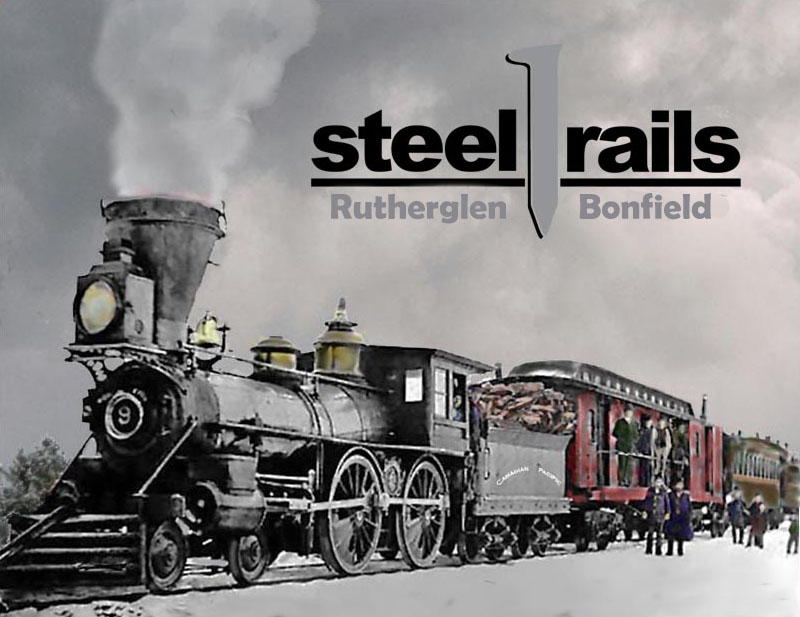
December 1882 the Canadian Pacific Railway arrived at the north shore of Lake Nipissing. The C.P.R. steam locomotive, the "Lucy Dalton," crept slowly past Ruther Glen along the newly laid track and became the first locomotive to reach what would become North Bay.
The arrival of the C.P.R. rail line connected the Nipissing District with more developed and prosperous areas in the southeast. Regular passenger service did not start until 1883.
Source: Steel Rails Museum, Rutherglen & Bonfield
Calgary Reached
The line reaches Calgary, in the North-West Territories' District of Alberta, as construction pushes rapidly westward under Van Horne's direction.
Regular Service to Winnipeg
Regular service to Winnipeg begins. By year's end, track has reached within eight kilometres of Kicking Horse Pass, laid largely by immigrant navvies, Stoney Nakoda workers, and some 17,000 Chinese labourers hired under harsh conditions in British Columbia.
The Railway Relief Bill
With funds running short, the government passes the Railway Relief Bill, extending a further $22.5 million in loans to keep construction moving.
The North-West Rebellion
Van Horne proposes moving troops to Qu'Appelle by rail within ten days. Though parts of the line remain incomplete, the journey is made in nine, an episode that does much to demonstrate the railway's strategic value to a still-skeptical government.
The Last
Spike
NOV 7, 1885
The Last Spike is driven at Craigellachie, British Columbia, by company director Donald Smith, completing the line from coast to coast. Four days earlier, the last spike of the Lake Superior section had been driven just west of Jackfish, Ontario.
The railway was finished four years behind the original 1881 deadline, but more than five years ahead of the revised completion date of 1891 that Macdonald had set in the interim. It was, by any measure, one of the great engineering undertakings of its century, and it came at a heavy human cost, particularly among the Chinese labourers who built the mountain sections through British Columbia.
The First Transcontinental Train
The first official transcontinental passenger train departs Montreal's Dalhousie Station on June 28, 1886, arriving at Port Moody, British Columbia, on July 4. The following spring, on May 23, 1887, the first official train reaches the railway's newly designated western terminus: Vancouver, formerly the small settlement of Granville.