Est. 1998 · Northern Ontario
Welcome To The Rutherglen Museum
Where iron rails and pioneer stories converge — preserving the heritage of Rutherglen and Bonfield.

Our Story
In 2023, Caren Gagne, Elmer and Christine Rose, and Steve Philpott learned that the Nipissing Railway Historical Society is working to restore a steam locomotive. The Historical Society intends to run a tourist train between North Bay and Bonfield/Rutherglen.
The four volunteers agreed that Bonfield Township should be prepared to host such a train. So, in 2024, they incorporated the "Steel Rail Group" nonprofit as an enterprise dedicated to stimulating interest in Bonfield Township.

T&NO No. 503 — Temiskaming & Northern Ontario Railway · The locomotive we aim to bring to life.
Why A Museum At Rutherglen?
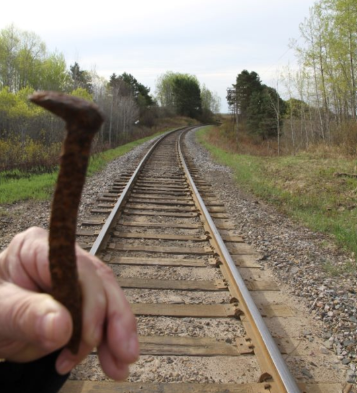
Symbolic Spike, Bonfield , Ontario
"Bonfield remains the official Eastern Terminus of the CPR construction project which ended in 1886 at Port Moody, British Columbia."
We are well placed to explore our local First Nation, Metis, French and English heritage — and to celebrate an early Canadian multi-cultural society in Bonfield Township, made possible by the Canadian Pacific Railway.
Feb 16, 1881 The Canadian Pacific Railway Company was incorporated. At a work camp named "Ruther Glen," a ceremonial First Spike was driven — for on that day, previous railroad construction extending from Eastern Canada had come to a halt at Ruther Glen.
Contractually, the new CPR was to meet eastern tracks 8 kms further west at "Callander Station." But in fact, the CPR met Eastern Canadian railbed construction at Ruther Glen.
The concept of a transnational "Pacific Railway" was adopted in 1871 as incentive to bring British Columbia into Confederation and ultimately populate Canada from coast to coast. Prime Minister Sir John A. MacDonald settled on a "neutral Gateway" equidistant from Toronto and Montreal — a point in the wilderness of Upper Canada east of Lake Nipissing, named Callander (later Callander Station, today the town of Bonfield, Ontario).
Today, Callander Station is called Bonfield, Ontario. Bonfield remains the official Eastern Terminus of the CPR construction project which ended in 1886 at Port Moody, British Columbia.
On February 15, 1881, Queen Victoria assented to legislation confirming a contract between the Canadian government and the newly formed Canadian Pacific Railway. The CPR was incorporated the following day and assumed responsibility for rail construction west of Callander Station to the Pacific Ocean.
This agreement also specified that Canada Central Railway Co. tracks, recently extended from Brockville and Ottawa in Eastern Canada, were to meet and connect with new CPR tracks at Callander Station. In the contract, Callander Station was given the title "Eastern Terminus" of the westbound CPR construction project.